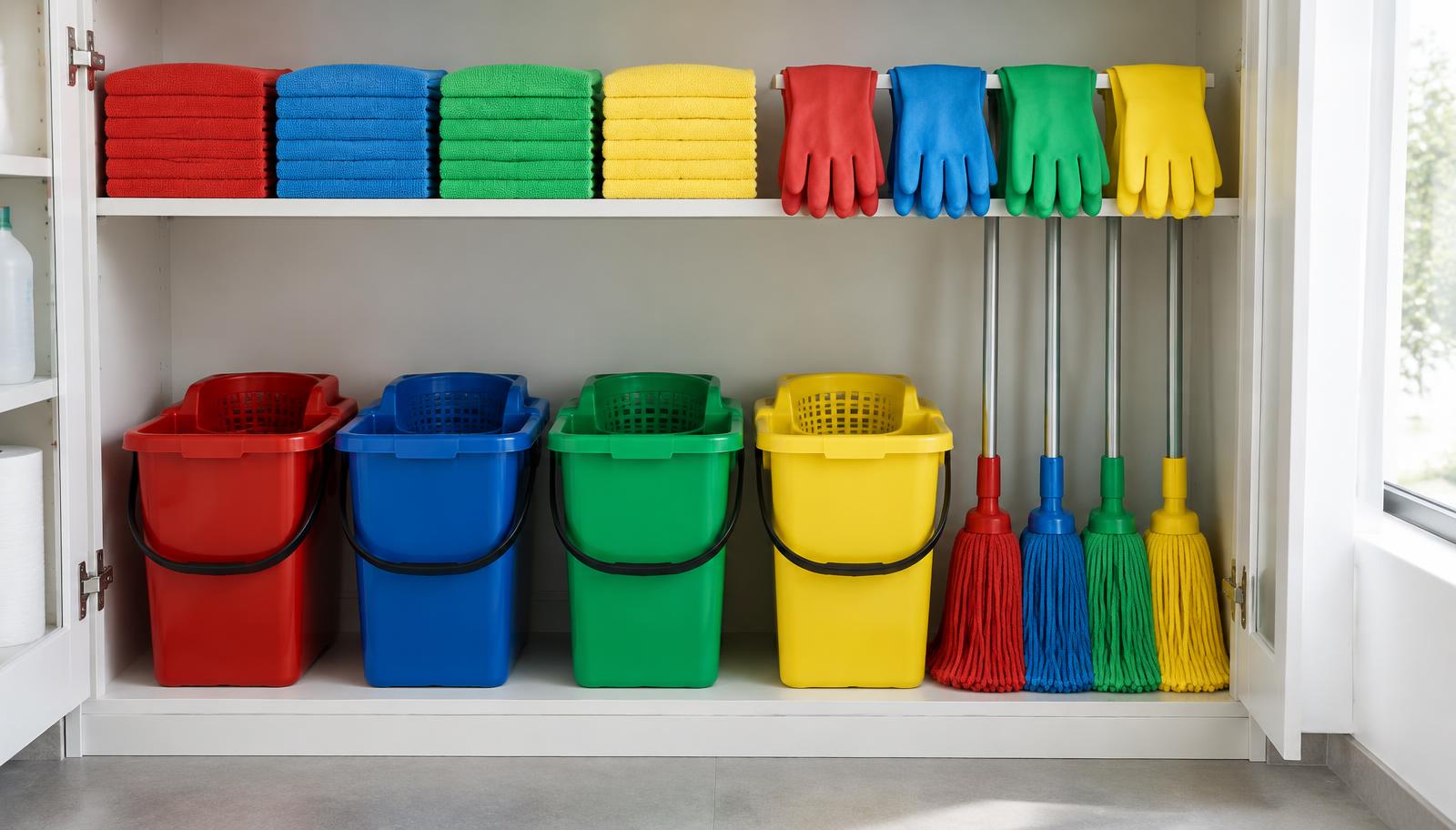
This article explains what each colour means, where the national scheme applies and how food hygiene guidance treats separate cleaning equipment. It is written for businesses, schools and healthcare settings that want to understand the system.
The article describes the position in England. Healthcare bodies in Scotland, Wales and Northern Ireland publish their own guidance.
The cleaning colour codes
The National Standards of Healthcare Cleanliness 2025 set out the national colour-coding scheme as follows:
| Colour | Areas in the national scheme |
|---|---|
| Red | Bathrooms, washrooms, showers, toilets, basins and bathroom floors |
| Blue | General areas, including wards, departments, offices and basins in public areas |
| Green | Catering departments, ward kitchen areas and patient food service at ward level |
| Yellow | Isolation areas |
NHS England gives an example: cloths (reusable and disposable), mops, buckets and non-disposable gloves that are colour-coded red are only used in bathroom facilities.
Why colour coded cleaning is used
NHS England states that the scheme reduces the risk of cross-contamination between different types of area, and that its simplicity means staff can easily observe this safe working practice. The standards add that the colour coding should be clear and permanent.
Colour coding is also checked during audits. Under the standards, efficacy audits observe cleaning as it happens and check that staff use colour coding correctly, alongside cleaning methods, PPE and chemical use.
What the scheme does not cover
The standards state that cleaning products, meaning chemicals and detergents, do not need to be colour coded. The coding also does not extend to catering equipment such as chopping boards and knives, which already have well-recognised procedures for food hygiene and food separation.
In healthcare settings, NHS England states that any deviation from the national scheme requires its approval. The National Standards of Healthcare Cleanliness are written for healthcare organisations. Our guide to the National Standards of Healthcare Cleanliness 2025 covers the wider standards.
Separate cleaning equipment in food businesses
Food hygiene guidance takes a similar approach to separating equipment. The Food Standards Agency's guidance on why cleaning is important advises using different cloths for specific tasks, such as a separate cloth for surfaces and for washing up, and different utensils, plates and chopping boards for ready-to-eat foods and raw foods that require cooking.
The same guidance explains the difference between cleaning products:
- detergents clean the surface and remove grease, but do not kill bacteria or viruses
- disinfectants kill bacteria and viruses, and should be used on a visibly clean surface for the specified contact time
- sanitisers kill bacteria but may not kill viruses, and can be used as part of a two-stage clean
Sources
Speak to our team
We clean offices, healthcare settings and commercial kitchens across Bristol and the surrounding area. Contact our team to arrange a site visit and a tailored quote.